Overview
Potential revenue from critical minerals to 2050 is estimated at 10–19 trillion pesos (about US$2.4–4.6 billion), equivalent to between 10 and 13 years of the environment ministry’s budget. Gross revenue from illicit gold in 2025 was estimated at 32–34 trillion pesos (about US$8 billion), or about 1.9% of GDP. China refines 60–90% of key transition minerals; efforts in Washington and Brussels to diversify supply create opportunities for suppliers with verifiable chains.
Enforcement concentrates on extraction, the lowest-value link in the chain, while the larger margins accrue downstream, among intermediaries, traders and exporters. The report argues that enforcement must address these other parts of the chain to reduce criminal income.
Findings
The revenue at stake in critical minerals is substantial — and a slice of it is already leaking to organised crime. What happens in the next five years will determine 2050 revenue.
Crime runs the length of the gold chain and is now moving into critical minerals — copper, niobium, tantalum — before the State has measured its footprint. It is already on the ground where critical minerals sit: Guainía, Vichada and the Venezuelan border along the Guiana Shield.
Illicit mining does more than skim rents. It poisons rivers and entrenches criminal governance that erodes national security. Banning formal mining backfires. It hands the ground to operators who answer to no environmental, tax or labour rules.
The two criminal economies do not share a geography. Illicit gold is consolidated in a western and central arc through Antioquia, Chocó and southern Bolívar. Critical minerals sit in the eastern borderlands, Vichada and Guainía, where documented seizures trace a corridor connecting Venezuela’s Orinoco Mining Arc to Colombian ports — and where armed groups are already positioned before extraction has properly begun.
Gold and critical minerals: different geographies
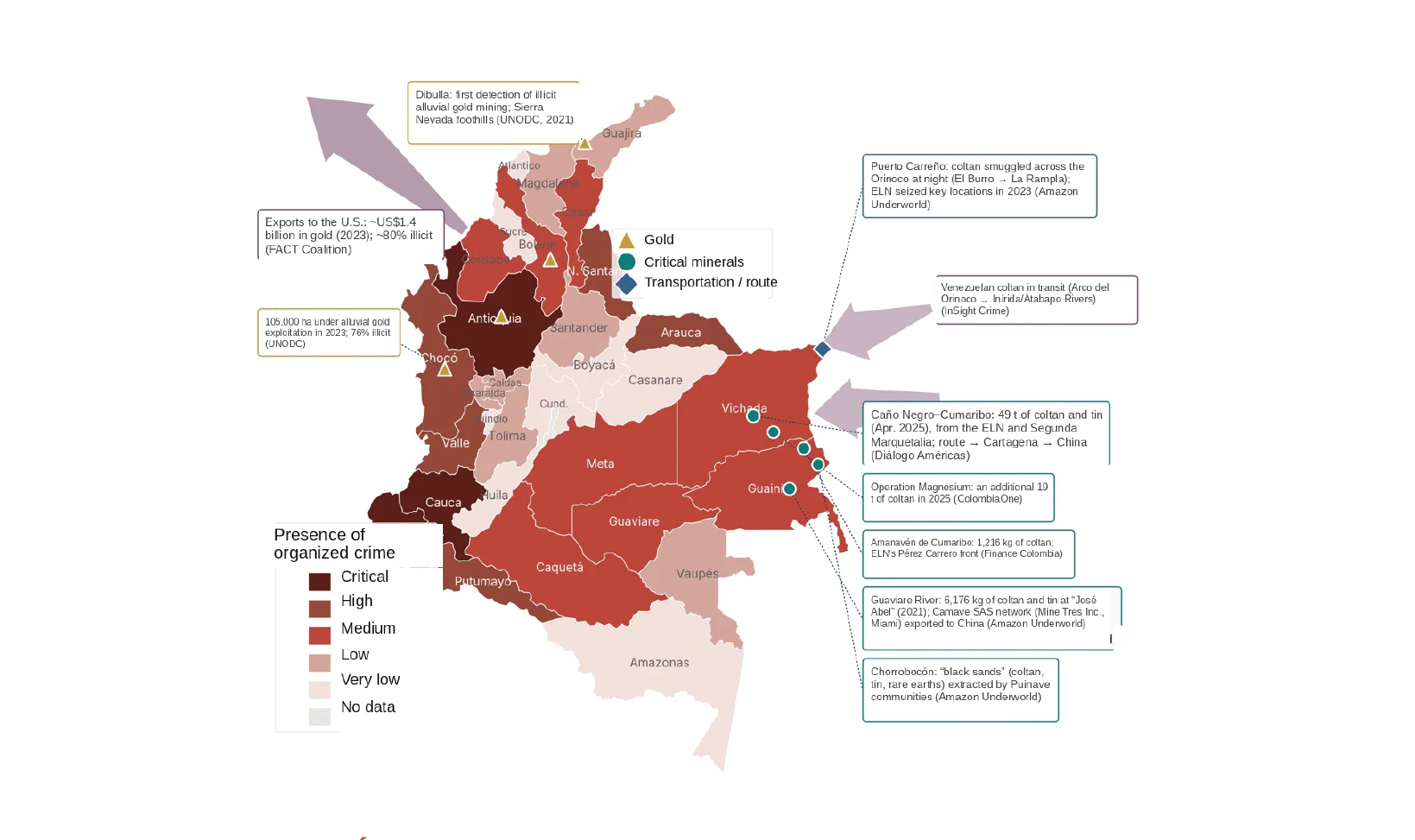
Figure description
Map of Colombia showing armed-group presence by department, illicit gold concentrated in the west and critical minerals activity along the eastern border with Venezuela
The fiscal stakes
In 2025, critical minerals generated 443 billion pesos (about US$110 million) in royalties and corporate income tax, with nickel accounting for nearly three-quarters of the total. Gold alone generated 2.6 trillion (about US$630 million) — more than all critical minerals combined.
| Mineral | Revenue (COP billion) |
|---|---|
| Nickel | 325 |
| Zinc | 36 |
| Copper | 31 |
| Silver | 29 |
| Platinum | 15 |
Because the mining cycle runs 15 to 22 years, licensing and regulatory decisions taken in the next five years will not show in 2030 revenue — but they largely determine whether Colombia reaches the ambitious scenario by 2050 or stays on the conservative path. Under the copper benchmark, in which production reaches 500,000 tonnes by 2050, the net present value of mining revenue reaches 189 trillion pesos (about US$46 billion), 10.2% of GDP.
Revenue scenarios to 2050
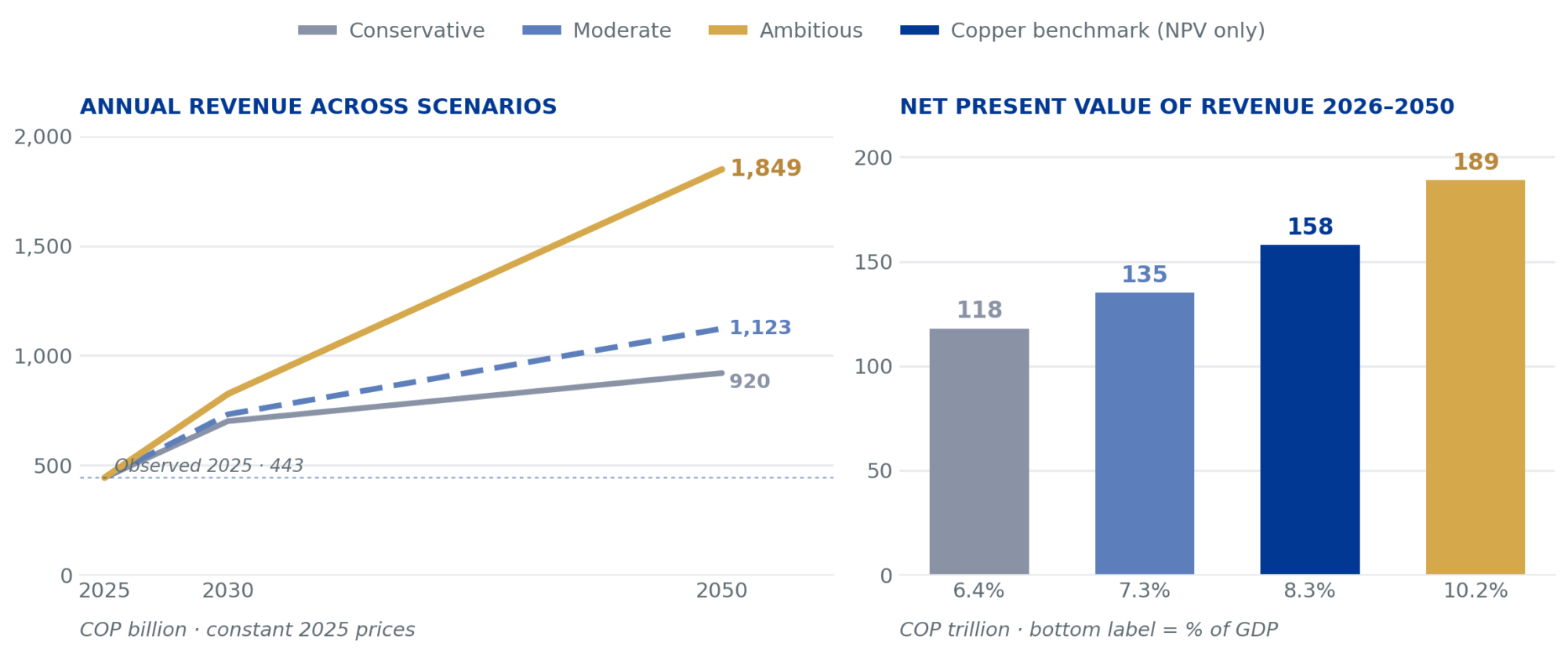
Figure description
Two charts: annual revenue from critical minerals to 2050 under conservative, moderate and ambitious scenarios, reaching 1,849 billion pesos in the ambitious case; and net present value of revenue 2026 to 2050 rising from 118 to 189 trillion pesos across scenarios
Full report
Authors: Jairo García, Nicolás Peña Tenjo and Enrique Sanz Posse. Bogotá, 2026.