Overview
This report examines Colombia’s potential revenues from critical minerals, organised crime’s involvement in mineral supply chains, and the policy changes needed to address it.
The net present value of revenue from critical minerals through 2050 is estimated at 10–19 trillion pesos (about US$2.4–4.6 billion), equivalent to between 10 and 13 years of the environment ministry’s budget. Gross revenue from illicit gold in 2025 was estimated at 32–34 trillion pesos (about US$8 billion), or about 1.9% of GDP. China refines 60–90% of key transition minerals; efforts in Washington and Brussels to diversify supply create opportunities for suppliers with verifiable chains.
Enforcement concentrates on extraction, the lowest-value link in the chain, while the larger margins accrue downstream, among intermediaries, traders and exporters. The report argues that enforcement must address these other parts of the chain to reduce criminal income.
Findings
Decisions on licensing and regulation over the next five years will shape Colombia’s mining revenues through 2050. The report examines how the State can capture these revenues and prevent their diversion to organised crime.
Criminal groups operate across the gold supply chain. There is also evidence of their involvement in copper, niobium and tantalum, although its extent remains uncertain. The report distinguishes criminally controlled extraction from artisanal and other informal mining.
Illicit mining damages rivers and strengthens armed groups’ control over communities. The report argues that restrictions on formal mining can leave more room for operators outside environmental, tax and labour rules.
Illicit gold mining is concentrated in Antioquia, Chocó and southern Bolívar. In the eastern borderlands of Vichada and Guainía, seizures indicate trafficking in minerals such as niobium and tantalum along routes connecting Venezuela’s Orinoco Mining Arc with Colombian ports. Armed groups are present in these areas, but further geological research is needed to establish the mineral resources.
Gold and critical minerals: different geographies
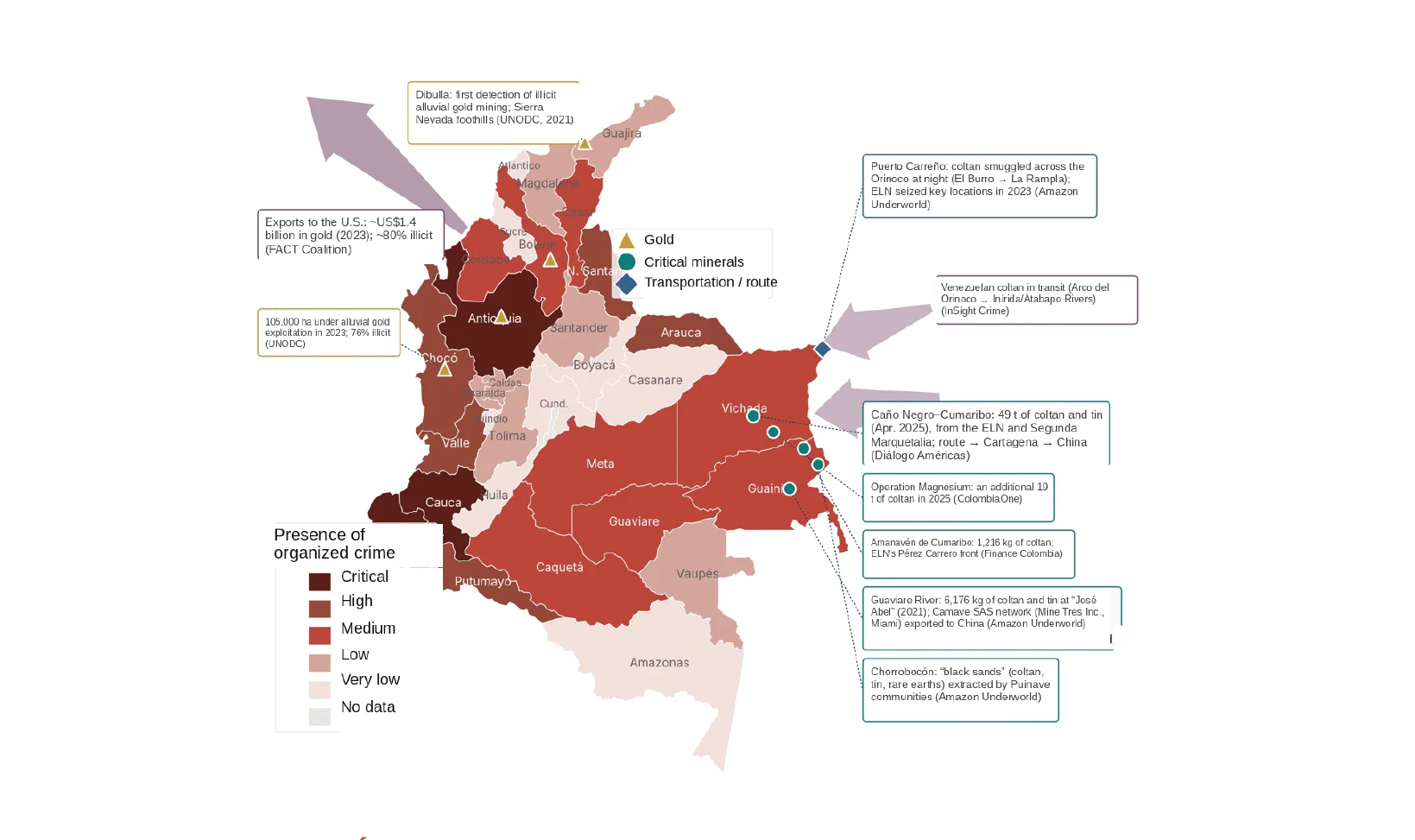
Figure description
Map of Colombia showing armed-group presence by department, illicit gold concentrated in the west and critical minerals activity along the eastern border with Venezuela
The fiscal stakes
In 2025, critical minerals generated 443 billion pesos (about US$110 million) in royalties and corporate income tax, with nickel accounting for nearly three-quarters of the total. Gold alone generated 2.6 trillion (about US$630 million) — more than all critical minerals combined.
| Mineral | Revenue (COP billion) |
|---|---|
| Nickel | 325 |
| Zinc | 36 |
| Copper | 31 |
| Silver | 29 |
| Platinum | 15 |
Mining projects take 15 to 22 years to develop. Licensing and regulatory decisions made now therefore affect long-term revenue rather than immediate returns. Under the copper benchmark, in which production reaches 500,000 tonnes by 2050, the net present value of mining revenue reaches 189 trillion pesos (about US$46 billion), 10.2% of GDP.
Revenue scenarios to 2050
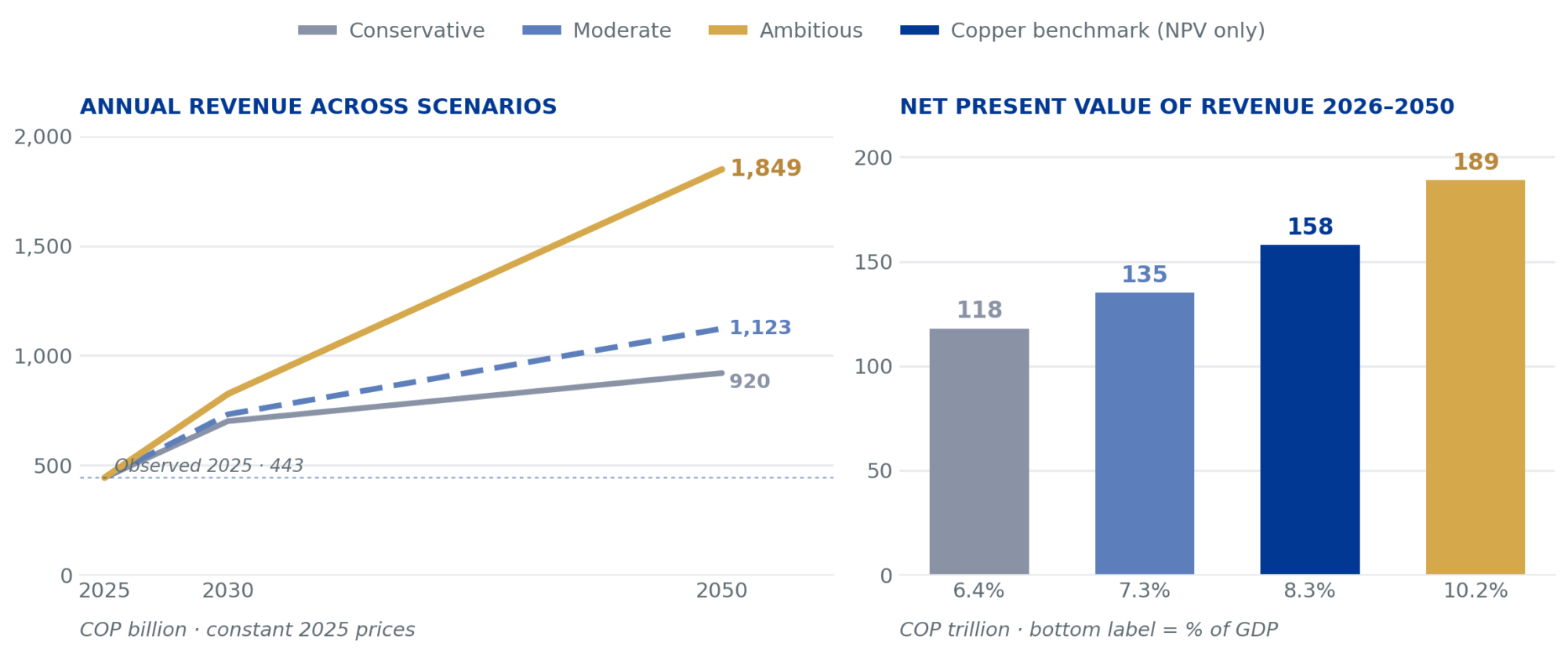
Figure description
Two charts: annual revenue from critical minerals to 2050 under conservative, moderate and ambitious scenarios, reaching 1,849 billion pesos in the ambitious case; and net present value of revenue 2026 to 2050 rising from 118 to 189 trillion pesos across scenarios
Full report
Authors: Jairo García, Nicolás Peña Tenjo and Enrique Sanz Posse. Bogotá, 2026.